
Last updated:
A bone graft is increasing bone volume by placing, in place of lost or insufficient bone, the person’s own bone, bone from a donor or a material that substitutes for bone. Enough bone is needed for an implant to stay firm; if there is little bone, a graft may come up before an implant. The dentist decides whether it is needed.
When someone who wants an implant hears the sentence "you have little bone, a graft may be needed" at the examination, they generally wonder two things: what exactly is a bone graft, and why is it needed? In this article we describe in plain language the bone graft, the situations in which it is planned and what is taken care over during the process.
What is a bone graft?
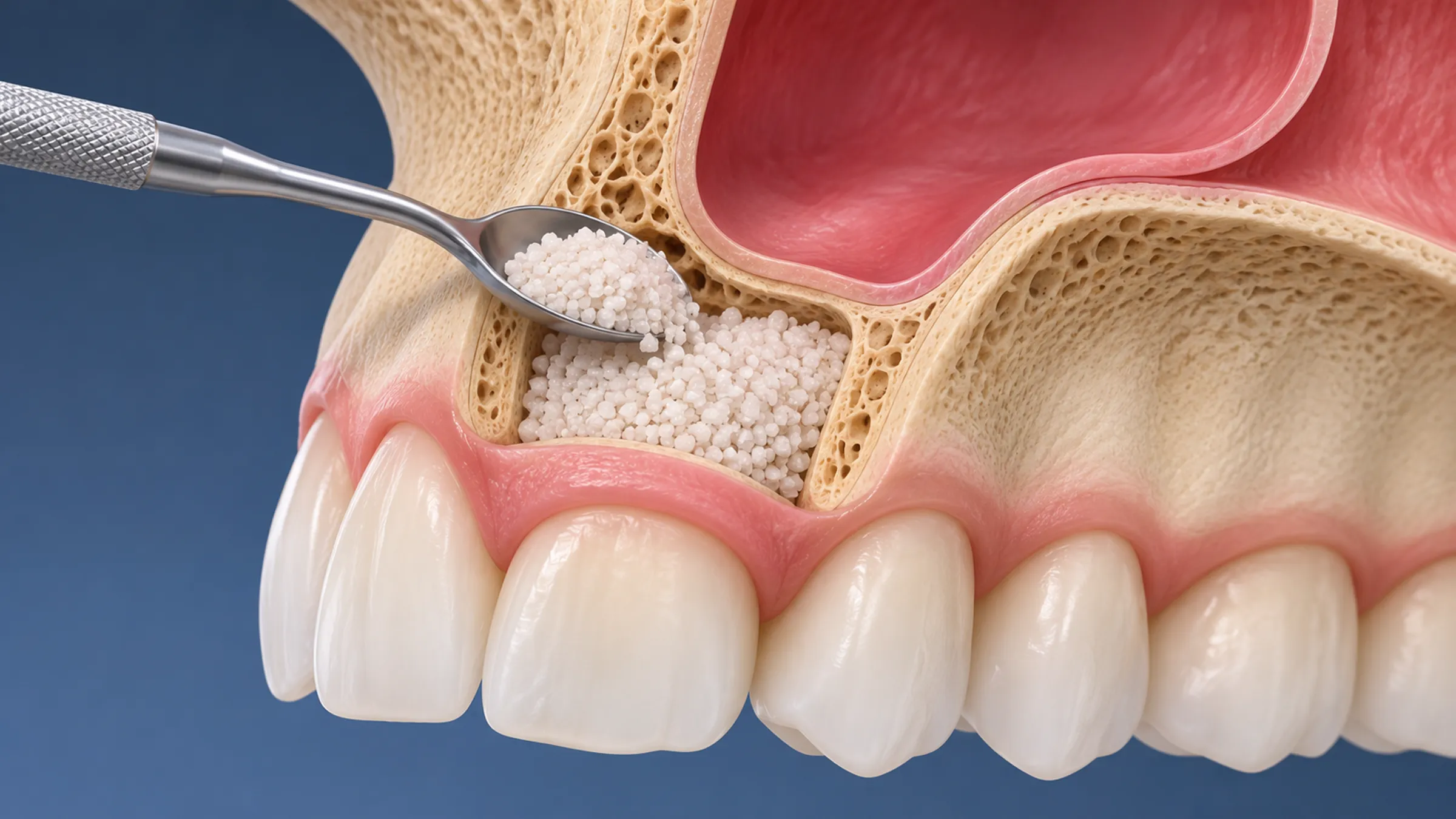
A bone graft is a procedure to support healing and bone formation by placing bone or a bone substitute in an area with bone loss or a bone defect. MedlinePlus states that, in general, a graft can come from the person’s own healthy bone (an autograft), from frozen donor bone (an allograft) or from an artificial bone substitute. In the mouth and jaw area, a graft is generally applied over a much smaller area and as part of dental surgery; the dentist decides on the material and the scope of the procedure.
Why might a bone graft be needed before an implant?
For an implant to stay firm in the jawbone, there needs to be enough bone around it. A review in the Cochrane Database puts it like this: enough bone is needed for dental implants to be adequately anchored, and for some patients implant treatment may not be possible without a bone augmentation procedure.
The main causes of insufficient bone are as follows:
- Reduction after tooth loss: When a tooth is absent, the bone around it can shrink over time.
- Gum disease: Advanced gum disease can lead to bone loss.
- Infection, a cyst or trauma: The bone in the area may have been damaged.
- Long-term denture use: In people who use a removable denture, the jawbone can change over time. The NHS states that dentures may become loose as the jawbone and gums change.
- Closeness of the sinus in the upper jaw: In the upper back region, the sinus cavity can limit bone height. For this, see our article on the sinus lift.
If the bone is sufficient, a graft may not be needed. So generalisations such as "everyone gets a graft" or "a graft is never needed" are not correct.
Types of graft
- Autograft: Bone taken from the person’s own body, from inside the mouth or from another area. It needs an additional donor site.
- Allograft: Processed bone taken from a donor of the same species.
- Xenograft: Processed bone material of animal origin; commonly used in dentistry.
- Synthetic graft: Materials made in a laboratory that substitute for bone.
Which material will be used depends on the size of the area, the type of bone defect and the dentist’s assessment. You can ask openly at the examination about your preferences and what you are wondering about the choice of material.
Of the graft types above, autograft, allograft and synthetic materials are also mentioned by MedlinePlus; xenograft is a term used in the dental literature, and we recommend that you get details from your dentist.
A graft is not a procedure that replaces the implant; it is a step that prepares the ground where the implant will sit.
Estelion Medical Editorial Team
How is a bone graft done?
The dentist first examines the area and assesses the height and width of the bone with imaging. The general flow in a graft procedure is as follows:
- The area is numbed; the type of anaesthetic to be used is planned by the dentist.
- The gum is opened to show the bone defect.
- The graft material is placed and is generally covered with a membrane.
- The gum is closed with stitches.
Bone augmentation may be in a horizontal (width) or vertical (height) direction; the Cochrane review examines both horizontal and vertical bone augmentation techniques. In addition, there are small grafts carried out together with an extraction to preserve the socket after it.
At the same time as the implant or separately?
In some cases the graft and the implant can be carried out in the same procedure; in others, the graft is placed first and the implant is done after a healing period. The decision is made according to the amount of missing bone and the initial stability of the implant. The healing time varies with the person and the procedure; your dentist will explain the plan. For the plan of the process, you can look at the article how many times do I need to come to Istanbul.
How does the graft become bone?
The graft material prepares the ground for new bone formation in the area where it is placed; over time it is expected to integrate with the surrounding bone tissue. How long this process takes varies with the type of graft, the size of the area and the person’s healing rate. So the treatment plan is often in stages, and the dentist decides when the implant will be placed from imaging and clinical checks. It would not be right to give a single length of time; you learn your own plan at the examination.
Approaches that avoid or reduce the need for a graft
Not every bone shortage is solved with a graft; nor is every graft the only option. Depending on the condition of the bone, the dentist may consider the following:
- Shorter or narrower implants
- Implants placed at an angle (the rear implants in plans such as All-on-4). For details see the article the difference between All-on-4 and All-on-6.
- Special approaches such as zygomatic or nasal implants in advanced bone loss in the upper jaw. Our article zygomatic or nasal implants instead of a bone graft and the zygomatic implants page cover this.
- Bridge or denture options instead of an implant; for these options, see the article missing tooth treatment.
Whichever is suitable is determined at the examination according to your bone structure and expectations.
Possible risks and healing
As with any surgical procedure, there are risks with a graft. MedlinePlus lists reactions to medication, bleeding and infection among the risks relating to general anaesthesia and surgery, and pain at the site the graft is taken from and damage to the surrounding nerves among the risks specific to graft surgery. This is information given for graft surgery in general; in dental practice the risks and scope may differ, and your dentist will give you personal information.
After the procedure, the following are taken care over:
- Following the dentist’s medication and care instructions
- Not putting strain on the surgical area; following the diet the dentist recommends
- Staying away from smoking and tobacco. The ADA states that tobacco use can slow healing.
- Attending check-up appointments
- Telling the dentist if there is swelling, bleeding, fever or increasing pain
For what is felt during and after the procedure, you can read the article what you feel during implant treatment.
Common misunderstandings
- "A bone graft is part of the implant." No; it is a separate procedure and is not needed with every implant.
- "If a graft is done, the implant will definitely hold." No such promise can be made for any procedure; results vary with the person, the area and care.
- "My own bone is always taken for a graft." No; there is more than one material option and the dentist makes their choice according to your situation.
- "No care is needed after a graft." Cleaning and check-ups are especially important during healing; for care after an implant, see the article care after an implant.
Preparing for the examination
Have with you the list of the medication you take, your known conditions and your allergies. If you have had jaw or dental surgery before, tell the dentist. If you take blood thinners, be sure to say so; MedlinePlus also states that blood-thinning medication needs to be discussed with the doctor before surgery. If you use tobacco, share this openly too.
If you have an X-ray taken earlier, it helps to bring it to the examination; however, it is not compulsory, because the necessary imaging is planned at the examination. For the general flow of the process, you can look at the article the first day of treatment in Istanbul.
Questions you can ask at the examination
- Is my bone sufficient for an implant? If not, in which area?
- Is a graft necessary, and what are the alternatives?
- Which graft material will be used, and why?
- Are the graft and implant done at the same time or separately?
- How is the healing period planned and which check-ups are needed?
For an implant for one or a few teeth, you can also look at our implants page. This article is for general information only; the final plan is determined after the dental examination in Istanbul.
Frequently asked questions
Does every implant need a bone graft?
No. If bone volume and quality are sufficient, a graft may not be needed. The dentist decides whether it is needed with an examination and imaging.
Is my own bone taken for the bone graft?
Not always. The graft material may be the person’s own bone, but it may also be material taken from a donor or material that substitutes for bone. The dentist chooses according to your situation.
Can a bone graft and an implant be done on the same day?
In some cases in the same procedure, in others after waiting for the graft to heal. This depends on the amount of missing bone and the dentist’s plan.
This article is for general information only and does not replace a diagnosis or treatment recommendation. Suitability for treatment and your treatment plan are determined after a dental examination.

Author
Estelion Medical Editorial Team
Estelion Medical