Last updated:
A sinus lift is a procedure in which, when bone height in the back of the upper jaw is insufficient for an implant, the floor of the sinus cavity is raised and bone or a bone substitute is placed beneath it. It is not needed in every implant patient; whether it is needed is decided by the dentist after an examination and imaging. In this article we explain what the procedure is in plain language.
Many people who have lost back teeth in the upper jaw meet the sentence "you do not have enough bone, a sinus lift may be needed" when they want an implant. When first heard, this phrase can cause worry. In this article we explain in plain language what a sinus lift is, in which situations it comes up and how the process goes.
What is a sinus lift?
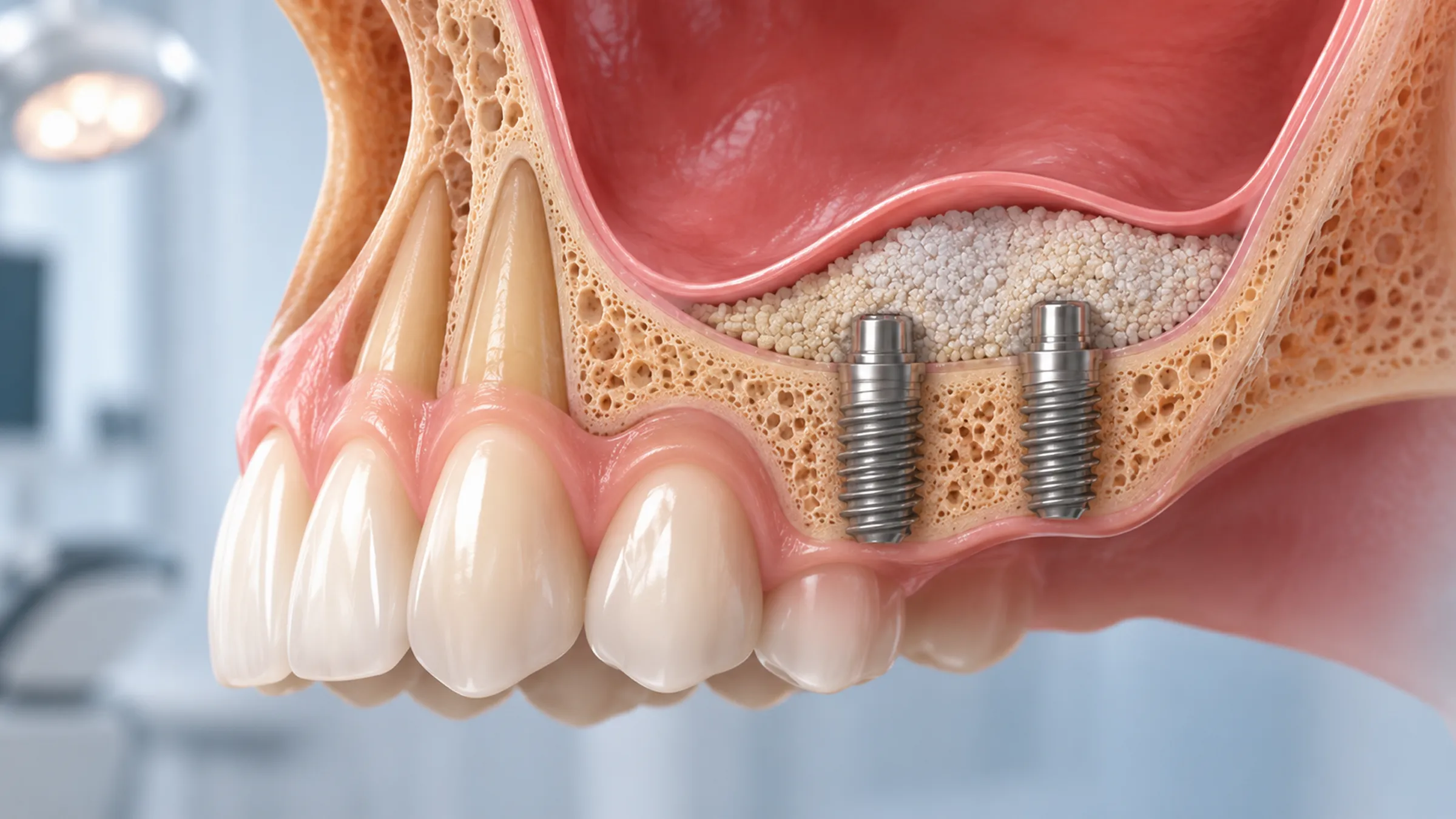
In the back of the upper jaw, inside the cheekbones, there are air-filled spaces: the maxillary sinuses. The roots of the upper back teeth are quite close to these spaces. When a tooth is lost, the jawbone can decrease over time and the sinus cavity can expand downwards. As a result, the bone height needed to place an implant may not be enough.
A systematic review published in the Cochrane Database summarises this situation as follows: when an implant-supported prosthesis is to be made in the back of the upper jaw, bone volume can be limited by the presence of the sinus and by reduced bone height. Sinus lift procedures increase bone volume by supporting the sinus cavity with bone (the person’s own bone) or ready-made biomaterials.
When is a sinus lift needed?
A dentist may consider a sinus lift in the following situations:
- An implant is planned in the upper back region and the distance between the sinus and the top of the bone is too short for an implant.
- The teeth were lost long ago and the bone has decreased over time.
- The sinus cavity is wide downwards.
If the bone is sufficient, a sinus lift is not needed. In some cases the dentist may consider shorter implants or a different plan. The Cochrane review examines studies comparing short implants with sinus lift where the remaining bone height is 4 to 9 mm, and reports that there is not enough evidence to show a difference between the two methods in the loss of prostheses or implants at one year, but that complications are seen more often at sites where a sinus lift is done. In other words, a sinus lift is not a standard applied to everyone but an option the dentist chooses where it is needed.
How is a sinus lift done?
The aim of the procedure is to carefully lift the thin membrane lining the sinus cavity, open up a space beneath it where bone will form and fill this with graft material. In general two approaches are described:
- The closed (crestal) method: The sinus floor is lifted slightly from the point where the implant will be placed. It may be preferred when a more limited lift is needed.
- The open (lateral window) method: A small window is opened in the bone on the side, and a larger area is lifted.
In studies comparing these techniques with each other, the Cochrane review reports no evidence that one technique results in fewer implant or prosthesis losses than another. The choice of technique is made by the dentist, taking into account the remaining bone height and the anatomy. The procedure can generally be carried out under a local anaesthetic; the dentist makes the decision. You also discuss the anaesthetic option at the examination.
Although a sinus lift can look like an "extra procedure", the aim is to prepare a bone foundation that will safely support the implant.
Estelion Medical Editorial Team
Together with the implant or separately?
In some patients a sinus lift and implant placement can be planned in the same session; in others the bone is built up first and the implant is placed after a certain healing period. Which is chosen depends on the remaining bone height and the initial stability of the implant. The dentist plans the healing times; how long they will be varies from person to person.
The graft material may be the person’s own bone, but it may also be material obtained from a donor or material that substitutes for bone. We described the types of graft and other aspects of bone augmentation in our article what is a bone graft.
Possible risks and things to watch for
As with any surgical procedure, a sinus lift has risks. The Cochrane review states that complications are seen more often at sites where a sinus lift is done. Common complications include tearing of the sinus membrane, infection and bleeding; you should get detailed information from your dentist at the examination. Matters such as medication, a history of allergy and tobacco use should be reported to the dentist. The ADA states that tobacco use can slow healing.
In some health conditions, for example an active sinus infection or nose and sinus diseases, additional assessment may be needed before the procedure. On this, your dentist may if necessary ask for the opinion of a relevant specialist.
What to watch for during healing
After the procedure, the instructions the dentist gives should come first. In general the following are discussed:
- Taking the medication the dentist prescribes regularly
- Warnings the dentist will give, such as not constantly poking at the surgical area, not blowing your nose hard and not straining your face or mouth
- Staying away from smoking and tobacco
- Attending check-up appointments
If there is something unexpected such as a runny nose, bleeding, swelling or pain, tell your dentist or our team. For communication after treatment, you can see the article who will I be in contact with after I return to my country.
Follow-up after the procedure
After a sinus lift, the dentist checks the healing of the area and decides when the implant will be placed or, if it has been placed, when the prosthesis will be made. These check-ups can sometimes include an X-ray or three-dimensional imaging. Not skipping check-up appointments matters so that possible problems are noticed early. For long-term care once the implant is complete, you can read the article care after an implant.
Options other than a sinus lift
If there is insufficient bone in the upper jaw, a sinus lift is not the only route. According to the bone structure, the dentist may consider short implants, implants placed at an angle or, in more advanced bone loss, special approaches such as zygomatic or nasal implants. For these matters, you can look at the article zygomatic or nasal implants instead of a bone graft and the zygomatic implants and nasal implants pages. Our implants page also gives information about individual teeth. For full-arch options, you can read the article options in complete tooth loss.
How is the need decided?
With a panoramic X-ray and, if needed, three-dimensional imaging, the dentist assesses the distance between the floor of the sinus and the ridge, the structure of the sinus walls and the width of the bone. At the clinical examination the remaining teeth, the condition of the gums and the balance of the bite are also examined. By combining all this information, whether a sinus lift is needed, which technique will be suitable and when the implant will be placed are planned. This plan is not settled without an examination; an article on the internet or an X-ray image does not replace the decision.
Common misunderstandings
- "If an implant is to be placed in the upper jaw, a sinus lift is a must." No. It comes up only if bone height in the upper back region is insufficient.
- "A sinus lift is nose surgery." No. The procedure is done from inside the mouth; the aim is not to treat a problem with the nose but to prepare a bone foundation for the implant.
- "Using a graft is the only option." The Cochrane review reports that, in comparisons of different grafts and techniques, there is not enough evidence that one method is superior to another; the choice depends on the dentist’s assessment.
- "No care is needed after the procedure." After the implant is in place, too, regular cleaning and check-ups are needed; see our article care after an implant.
A sinus lift is a type of bone augmentation and, like all bone augmentation, is carried out according to the dentist’s plan. Before deciding, it is right to talk through the benefits, risks and options of the procedure with the dentist.
Preparation before the procedure
When you come to the examination, it helps to bring a list of the medication you take and your known conditions, and to mention any allergy. If you have had sinus or nose surgery before, say so. If you use tobacco, share this openly; the dentist plans the healing process accordingly if needed. For travel preparation, you can make use of our travel guide.
What is discussed at the examination?
- How are the bone height in the upper jaw and the condition of the sinus assessed?
- Is a sinus lift necessary for me, and what are the alternatives?
- Is the procedure done in the same session as the implant or separately?
- How is the healing period planned and which check-ups are needed?
This article is for general information only; the final plan is determined after the dental examination in Istanbul.
Frequently asked questions
Is a sinus lift essential for an implant in the upper jaw?
No. It comes up only if bone height in the upper back region is not enough for an implant. If the bone is sufficient it is not needed; the dentist decides with imaging and an examination.
Is there another option instead of a sinus lift?
Depending on the bone, short implants, differently angled implants or special approaches may be considered. Which option is suitable is determined at the dental examination.
Is the implant placed straight after a sinus lift?
In some patients it is done in the same session, in others after a healing period. This depends on the remaining bone height and the dentist’s assessment.
This article is for general information only and does not replace a diagnosis or treatment recommendation. Suitability for treatment and your treatment plan are determined after a dental examination.

Author
Estelion Medical Editorial Team
Estelion Medical