
Last updated:
The main options for treating complete tooth loss are a full denture that is taken out and put back in, an implant-retained removable denture held on a small number of implants, and a full-arch prosthesis fixed on implants (such as All-on-4 and All-on-6). Which is suitable is determined at the dental examination according to bone structure, general health and expectations. In this article we compare each approach in plain language.
For someone who has lost all or most of their teeth, the options often look confusing: "Should I carry on with dentures, should I have implants, is a fixed solution really possible?" In this article we explain in plain language the approaches used in complete tooth loss, how each works and which points are looked at when deciding.
Options in treating complete tooth loss
For a jaw with no teeth, treatment falls into three groups according to the point of support:
- The conventional full denture: A denture that rests on the gums and palate and is taken out and put back in.
- Implant-retained removable denture (overdenture): A denture that is held on a small number of implants in the jawbone and is still taken out for cleaning.
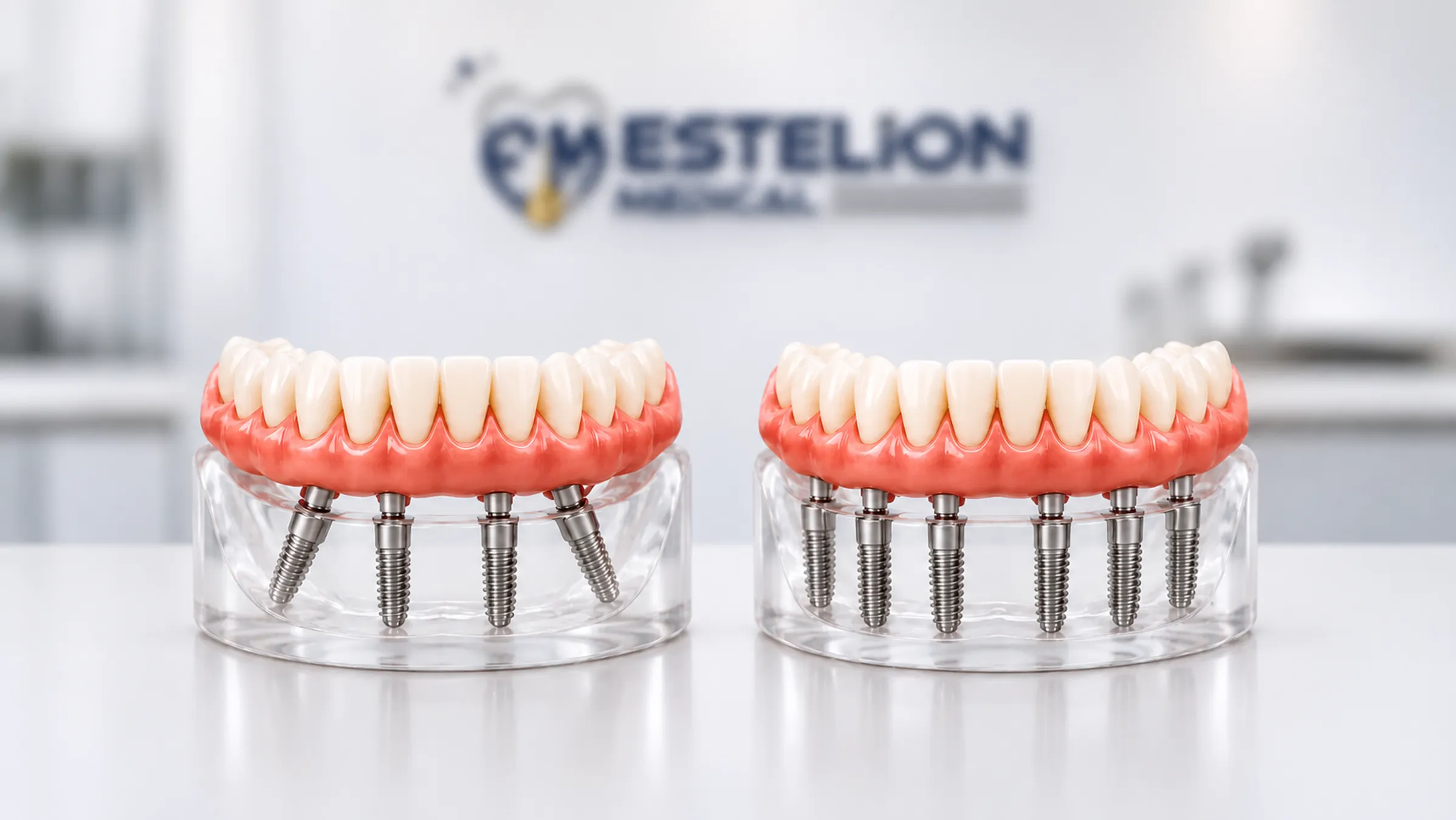
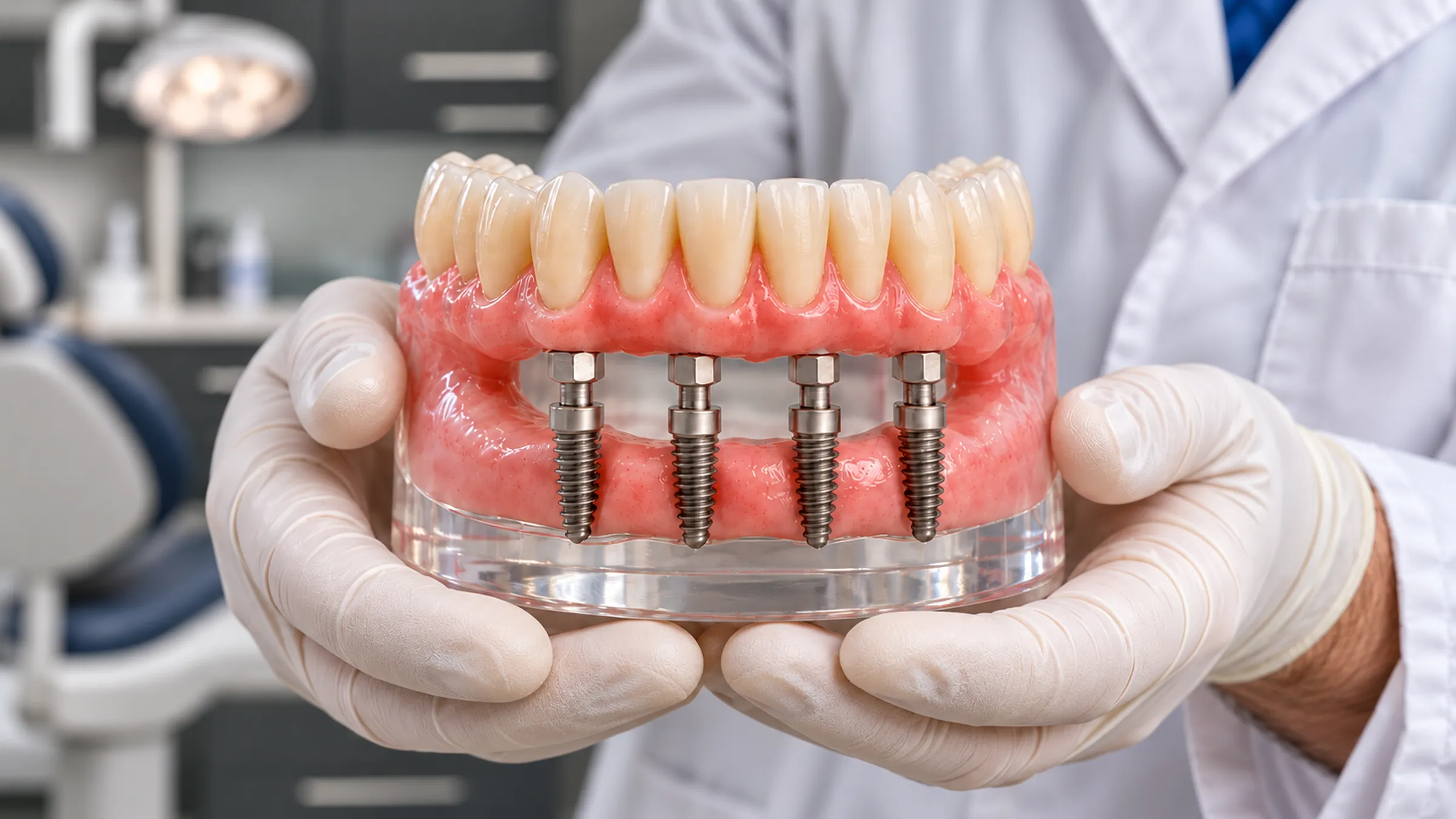
- Fixed implant-supported prosthesis: A full-arch prosthesis screwed onto four, six or however many implants the dentist plans, which only the dentist can remove from the mouth.
The conventional full denture
The ADA describes full denture types under three headings: the conventional denture made after the teeth have been extracted and the tissue has healed; the immediate denture fitted on the day the teeth are extracted, which may need to be renewed or adjusted after healing; and the overdenture that sits over remaining teeth or implants. Dentures can make eating and speaking easier and can support the appearance of the face.
The process of getting used to them varies from person to person. The ADA and NHS state that new dentures may feel unusual for a few weeks and that mild irritation or increased saliva may be seen. According to the NHS, dentures can become loose as the gums and jawbone shrink or change shape over time; so regular check-ups and, if needed, replacement are required. In daily care it matters that dentures are cleaned every day and stored at night as the dentist recommends.
Implant-retained removable denture
In this approach the denture is held on a few implants placed in the jawbone. The denture is still taken out and cleaned, but thanks to the implants it is intended to sit more stably in place. The ADA states that implants can support an overdenture. The York Consensus Statement published in 2009 by the British Society for the Study of Prosthetic Dentistry (BSSPD) in the UK also argues that, for the lower jaw, an overdenture supported by two implants should be the first-choice standard for edentulous patients; this statement is a compilation of expert opinion and does not describe the same result for every patient.
In the upper jaw the bone structure and the anatomy of the palate are different; so the number and placement of implants are planned separately. The number of implants, the design of the prosthesis and its care are the dentist’s decision.
Fixed implant-supported prosthesis: All-on-4 and All-on-6
In All-on-4 and All-on-6, a fixed prosthesis carrying all the teeth in one jaw is attached to four or six implants. In All-on-4 the rear implants are mostly placed at an angle; the aim is to make use of suitable implants even when bone in the rear region has decreased. In All-on-6 the implants are distributed over more points along the jaw. You can read our article the difference between All-on-4 and All-on-6, which explains the difference between the two methods in detail. Our treatment pages: All-on-4 and All-on-6.
Unlike a removable denture, a fixed prosthesis is not taken out of the mouth. However, this does not mean it needs no care; the area around the implants and under the prosthesis is cleaned regularly and check-ups are carried out. For more information you can see our article care after an implant.
More implants or a fixed prosthesis does not mean "more suitable" for every patient. The plan is made according to the bone, the shape of the jaw and your habits.
Estelion Medical Editorial Team
Side-by-side comparison
- Removability: A full denture and an overdenture are taken out and cleaned; a fixed prosthesis is removed by the dentist.
- Surgery: A conventional full denture generally does not need implant surgery; the other two do.
- Bone requirement: With the implant options, bone volume and quality are assessed. If it is insufficient, bone augmentation may come up; for details see our article on the bone graft.
- Upper jaw: In the upper jaw, because of the closeness of the sinus, a sinus lift may be needed.
- Getting used to it: With every option there is a period of getting used to it; how it feels varies from person to person.
- Follow-up: All need regular check-ups; the prostheses may need adjusting or replacing over time.
How is the decision made?
At the examination the dentist examines your jaw, gums and any remaining teeth; with a panoramic X-ray and, where needed, three-dimensional imaging, assesses the height and width of the bone and its closeness to structures such as the sinus and nerves. The following are then discussed:
- General health, medication and tobacco use. The ADA states that chronic conditions such as diabetes, and tobacco use, can affect healing.
- The condition of the remaining teeth; whether any need to be extracted
- A habit of clenching or grinding
- Whether you want fixed or removable; whether taking the prosthesis out and putting it back suits you
- Whether you can attend follow-up appointments and your care routine
The dentist may sometimes divide the final plan into two stages; such as starting with a temporary prosthesis and making the final prosthesis after healing. For temporary options, have a look at the article can I go home with a temporary prosthesis. The final plan is determined after the dental examination in Istanbul.
If teeth are still in the mouth: extraction and the transition period
Some patients are not completely edentulous; extraction may be needed because their remaining teeth are unhealthy. In this case the dentist plans whether to proceed with a temporary prosthesis fitted straight after extraction or with a prosthesis made after healing. According to the ADA, an immediate denture can be fitted on the day the teeth are extracted; however, because the jaw changes shape as it heals, it may need to be adjusted or replaced later. How this transition period is managed varies from person to person.
What changes in daily life?
For someone who has lost their teeth, the most noticeable matters are eating, speaking and smiling with confidence. With removable dentures these matters depend on the process of getting used to them: the ADA explains that new dentures may feel odd or loose for the first few weeks and that the cheek and tongue muscles learn to hold the denture in place. With fixed implant prostheses the process of getting used to them is different; because the prosthesis is not taken out, the feeling in daily use may be different, but here too check-ups and care need to be carried out regularly. Remember that these feelings can vary from person to person; experiences are never identical.
Advice on diet varies with the healing period. Soft foods are often recommended in the first weeks; the ADA also states that soft and cold foods and warm soup may be recommended during implant healing. Your dentist guides your own diet plan.
Common misunderstandings
- "If you have no teeth, the only solution is dentures." No; there are also implant options, and suitability is determined by the dentist.
- "A fixed prosthesis needs no care." With fixed prostheses too, the area around the implants and under the prosthesis is cleaned regularly.
- "More implants are always more suitable." The number alone does not decide it; bone structure and prosthesis design also matter.
- "A fixed prosthesis can be made for everyone." For some patients, because of bone, general health or habits, a different option may be more suitable.
So the decision needs to be made not from an article or a brochure on the internet but together with the dentist after an examination.
The process and follow-up
In treatments with implants, a healing period for the bone to fuse around the implants may be planned. How long this lasts varies with the person and the plan. More than one visit may be needed; for information about the process you can read the article how many times do I need to come to Istanbul. On check-ups after you return to your country, the article who will I be in contact with after I return to my country is a guide. For your travel plan, our travel guide is ready.
Questions you can ask at the examination
- Which options look suitable for me, and why?
- In how many stages and visits will treatment be completed?
- Will a temporary prosthesis be needed, and what arrangement awaits me?
- Which brands are used? (See the article what to look at when choosing an implant brand.)
- What will the care and check-up programme at home be?
This article is for general information only; it does not replace a diagnosis or treatment recommendation.
Frequently asked questions
Is a full denture the only option for complete tooth loss?
No. Besides a full denture, there are also implant-retained removable dentures and full-arch prostheses fixed on implants. Which is suitable is determined at the dental examination according to bone structure and general health.
Can All-on-4 and All-on-6 be done for everyone?
They may not be suitable for every patient. Bone volume, jaw shape, general health and habits are assessed; if needed, a different option is suggested. The final decision is made after the dental examination in Istanbul.
Is a fixed full-arch prosthesis taken out for cleaning?
No, only the dentist removes a fixed prosthesis. However, the underside of the prosthesis and the area around the implants are cleaned at home with special tools and regular check-ups are needed; your dentist will show you a suitable care method.
This article is for general information only and does not replace a diagnosis or treatment recommendation. Suitability for treatment and your treatment plan are determined after a dental examination.

Author
Estelion Medical Editorial Team
Estelion Medical